The Madras High Court has restrained the construction of a church near a 100-year-old Mariyamman temple in Coimbatore, after observing that mala fide intentions could not be ruled out if a large church was proposed in the vicinity of the temple [Balasubramaniyam Vs Collector].
A Bench of Justices GR Swaminathan and V Lakshminarayanan passed the interim order on May 29 in a writ petition filed by Balasubramaniyam N, a resident of Kalapatti in Coimbatore.
The Court observed that the dispute involved the proposed construction of a large church in the immediate vicinity of a temple, in a communally sensitive city like Coimbatore.
“Coimbatore is a communally sensitive city. It witnessed bomb blasts and bloody religious riots. It witnessed bomb blasts and bloody religious riots. The proposed church would come up within a stone’s throw from the existing Mariyamman Temple. There are only a handful of Christian families. If a large church is proposed to be constructed in the vicinity of the Mariyamman Temple, mala fide intentions cannot be ruled out," the Court said.
The Court also noted that Hindus constituted an overwhelming majority in the locality and had vigorously opposed the construction of a church in the immediate vicinity of the temple.
“When Hindus constitute an overwhelming majority and they vigorously oppose the construction of a church in the immediate vicinity of the temple, then, the authority must not casually brush the objection aside,” the Court said.
Justice GR Swaminathan and Justice V Lakshminarayanan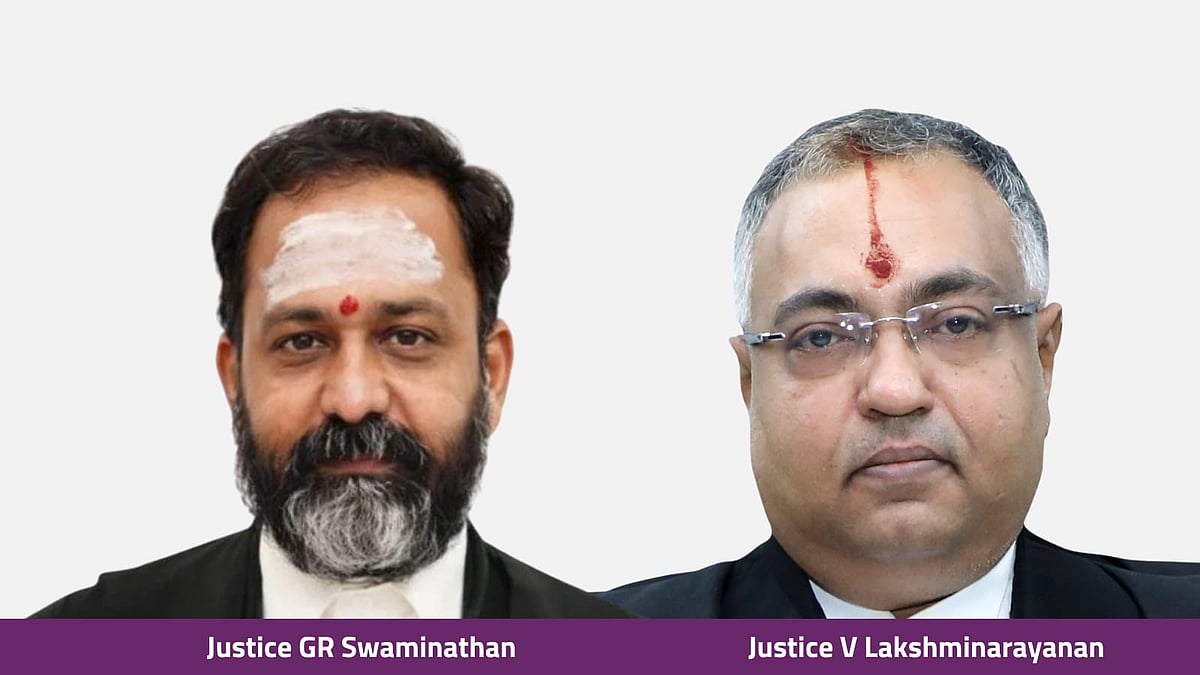
Coimbatore is a communally sensitive city... If a large church is proposed to be constructed in the vicinity of the Mariyamman Temple, mala fide intentions cannot be ruled out
Madras High Court
The Court also noted that the petitioner’s counsel had pressed for an urgent hearing of the matter by referring to the recent change in the State regime, with the appointment of C Joseph Vijay as the new Chief Minister.
The counsel argued that certain fundamentalist organisations have become emboldened after this change in the government. He also referred to Speaker JCD Prabhakar quoting biblical verses in his inaugural address to the Assembly, Udhayanidhi Stalin’s remarks calling for the "annihilation of Sanatana dharma” and posters in parts of Tamil Nadu calling for churches in every village.
The petitioner claimed that the proposed construction was on government poramboke land and a public road. He sought the quashing of the official communications and a direction to remove the alleged illegal construction.
The Court noted that the Mariyamman temple was located in Survey No.155/1 and had admittedly existed for more than 100 years. It also recorded that permission had been granted in 2010 for the construction of a church in Survey No.155/2 despite opposition from Hindus in the locality.
A civil suit challenging the 2010 permission is pending before the District Munsif Court, Coimbatore. The Court also noted that in an earlier writ petition filed by the Church of South India, the High Court had granted liberty to make a fresh application for construction only after the disposal of the civil suit.
The Bench perused the revenue records and found that Survey No.155/2 was recorded as a tar road.
“Title cannot vest in a private body when the revenue record indicates that it is a public road,” the Court said.
The Bench also recorded the petitioner’s submission that the village originally had about 350 families, of which only three professed Christianity. It was further claimed that there were now around 1,000 families, of whom 950 professed Hinduism, 15 professed Islam and only a few professed Christianity.
The Bench acknowledged that Article 25 of the Constitution protects the right to profess, practise and propagate religion. However, it added that the right is subject to public order.
The Court clarified that the State need not submit merely because the majority has opposed the proposed church construction.
“If right is established or if the opposition is found to be unreasonable, then, the State should go to any extent to uphold the right,” it said.
However, in the present case, the Bench found that a prima facie case had been made out to restrain the church's construction for now.
“Irreparable hardship and loss will be caused to social amity if interim order is not granted,” the Court held.
The Court also made it clear that any change in the political situation would not alter the legal position.
“The political scenario may change. But so long as the position of law remains what it is, it is our duty to give effect to the same,” the Bench said.
The petitioner was represented by Advocates D Baskar, E Ashok Kumar, KB Rohitih, Pooja J and B Sankara Narayanan.
Additional Government Pleader LSM Hasan Fizal appeared for the government respondents.
Additional Public Prosecutor R Muniyapparaj appeared for the police.
For More News Updates Follow Us On www.tconews.in