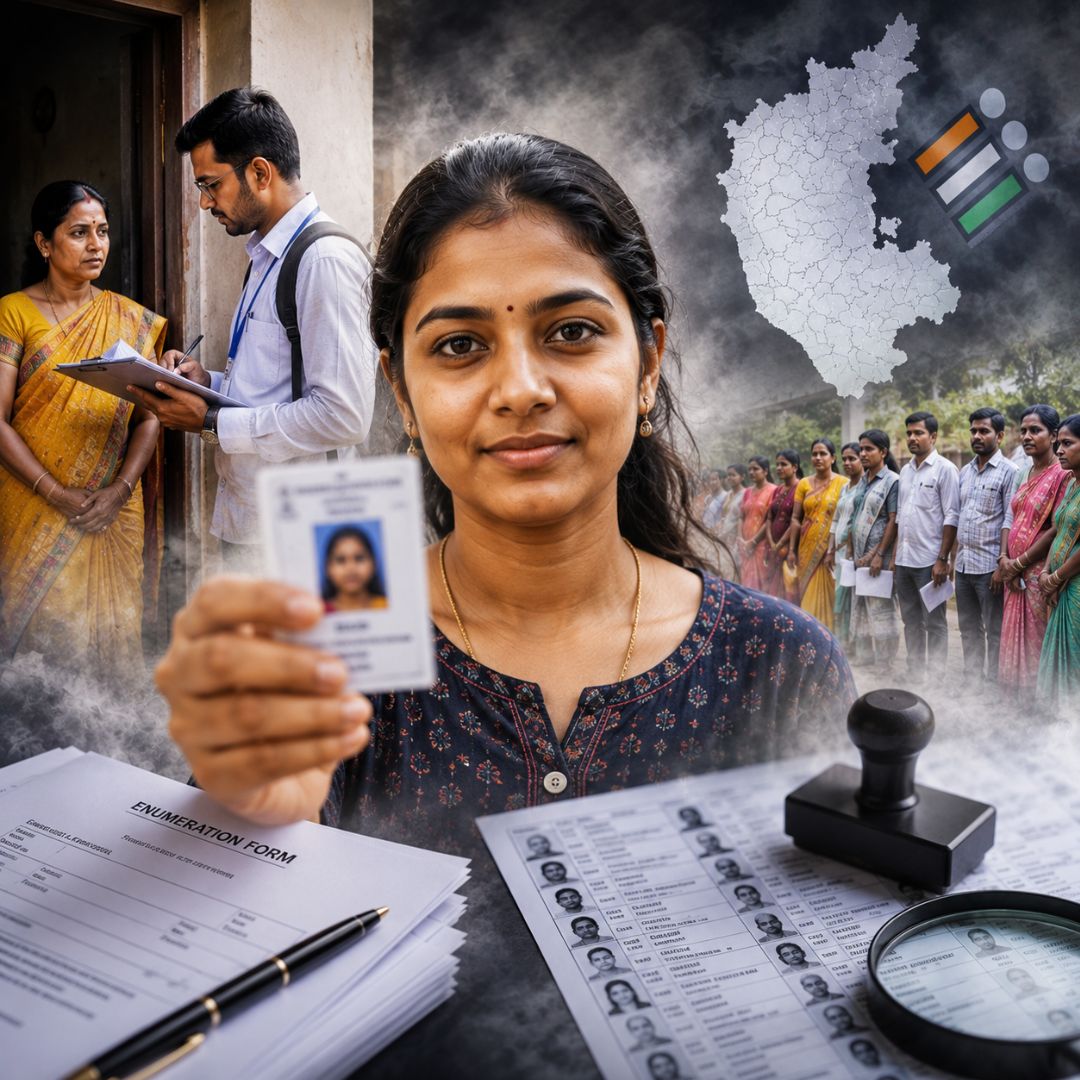
The Election Commission of India (ECI) has begun the door-to-door enumeration phase of the Special Intensive Revision (SIR) of electoral rolls across Karnataka from 30 June 2026, marking one of the country’s most extensive voter verification exercises in recent years.
The exercise aims to prepare a “pure, accurate and inclusive” electoral roll ahead of future elections by requiring Booth Level Officers (BLOs) to visit every household, distribute enumeration forms, collect completed forms, verify voter information and prepare a fresh draft electoral roll.
Unlike the routine annual Summary Revision, where voters themselves submit applications for additions, corrections or deletions, the SIR places the responsibility on election officials to physically verify eligible electors.
The initiative has generated considerable public and political debate, with the Election Commission maintaining that the exercise is intended to improve the integrity of electoral rolls, while opposition parties and several civil society groups have raised concerns about documentation requirements, the possibility of eligible voters being excluded and the logistical challenges of completing such a large-scale verification exercise within the stipulated timeline.
The Commission has urged voters to cooperate with BLOs and submit their forms on time, emphasising that every eligible citizen will have multiple opportunities to establish their eligibility before the final electoral roll is published.
Understanding The Enumeration Process
The Special Intensive Revision differs significantly from previous revision exercises because it begins with field verification rather than relying primarily on applications submitted by electors. As part of the process, Booth Level Officers are visiting households across Karnataka to distribute the official Enumeration Form, explain the information required, assist voters where necessary and collect completed forms within the prescribed period.
Electors are expected to verify personal details such as their name, age, gender, address and polling station particulars while declaring that they are ordinarily resident at the address mentioned and are not enrolled elsewhere.
Where required, supporting documents relating to age, identity or residence may be sought to facilitate verification, although the Election Commission has repeatedly stated that the objective is to ensure inclusion rather than create barriers for genuine voters.
Once forms are collected, BLOs will verify the information through field visits and official records before electoral registration officers prepare a draft electoral roll. This draft will subsequently be published for public scrutiny, allowing voters to file claims and objections before the final roll is notified.
Election Commission officials have described the SIR as a systematic exercise to improve the quality of electoral rolls through direct verification rather than relying solely on periodic corrections.
According to the Commission, the revision seeks to remove duplicate entries, update records of deceased or shifted voters and ensure that every eligible citizen is enrolled at their ordinary place of residence.
Officials have also highlighted that electors who are unavailable during the initial household visit will not automatically lose their voting rights, as multiple opportunities will be provided to submit forms, respond to verification queries and file claims during the draft publication stage.
Citizens can also seek assistance from Booth Level Officers, Electoral Registration Officers and designated election offices for clarifications regarding documentation, timelines or corrections.
Why SIR Has Sparked Debate
Electoral rolls in India are routinely updated through the annual Summary Revision process, under which citizens voluntarily apply to enrol as first-time voters, transfer their names after shifting residence, correct inaccuracies or request the deletion of deceased family members.
Alongside these annual revisions, the Election Commission has historically undertaken Intensive Revisions every five to ten years, during which Booth Level Officers physically verify elector details in the field.
However, election experts note that the present Special Intensive Revision represents a more comprehensive verification exercise because it effectively revalidates the electoral roll through household enumeration before publishing a fresh draft.
The announcement of the Karnataka SIR has therefore attracted significant political attention. While the Election Commission argues that the exercise is essential to maintain accurate and inclusive electoral rolls, opposition parties have questioned whether the verification process could inadvertently disenfranchise eligible voters if documentation is incomplete or households are missed during field visits.
Civil society organisations and election observers have similarly called for maximum transparency, greater public awareness and adequate safeguards to ensure that vulnerable communities including migrant workers, senior citizens, persons with disabilities, economically disadvantaged families and people living in remote areas are not excluded due to procedural challenges.
Election authorities have responded by reiterating that the SIR includes multiple layers of verification, opportunities to file claims and objections, and statutory appeal mechanisms before any final electoral roll comes into force.
According to the schedule released by the Election Commission, the door-to-door enumeration phase commenced on 30 June 2026 and will be followed by verification of submitted forms, preparation of the draft electoral roll, a period for public claims and objections and subsequent hearings before the publication of the final electoral roll.
Officials have encouraged voters not to wait until the final stages but instead cooperate with Booth Level Officers during household visits, verify all personal information carefully and promptly report any discrepancies to local election authorities.
The Logical Indian’s Perspective
Free, fair and inclusive elections depend not only on robust electoral laws but also on public confidence in the processes that determine who gets to vote. An accurate electoral roll strengthens democracy by reducing duplication, correcting outdated records and ensuring that every eligible citizen can participate in the democratic process.
At the same time, any exercise of this scale must be implemented with transparency, accessibility and sensitivity, especially when it affects millions of voters with diverse social, economic and educational backgrounds. Administrative efficiency should never come at the cost of inclusion, and public communication must be clear enough to prevent misinformation, confusion or unnecessary anxiety among voters.
For More News Updates Follow Us On www.tconews.in