
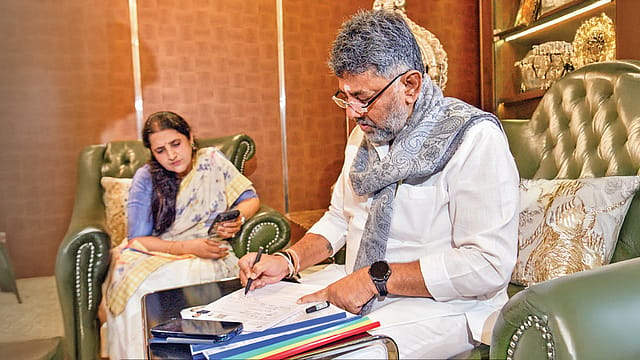
 Karnataka Chief Minister DK Shivakumar fills up the SIR form, Bengaluru, June 30, 2026 (Photo: ANI)
THE NEWEST DOCUMENT to broil Karnataka’s politics is one that almost nobody seems to know how to obtain. The Congress government has presented the Permanent Residence Certificate, or PRC, as a shield for “genuine” residents who may struggle to establish eligibility during the Election Commission of India’s (EC) ongoing Special Intensive Revision (SIR) of electoral rolls. The order notifying it does not mention SIR but Chief Minister DK Shivakumar made the connection himself at a press conference on June 29, the day before the revision began. The move has all the makings of being another political joust over SIR even if less violent and confrontational than the battle in West Bengal.
Residents interviewed for this story were either unaware of the PRC or confused it with the older domicile or residence certificate and their doubts are not without basis. Jagadish K Naik, a Karnataka Administrative Service officer and additional deputy commissioner of Bengaluru Urban district, said no PRC had been issued in the city. “The procedure for applying for a PRC is not yet clear. There are a number of certificates that are recognised by EC, including caste certificates and Aadhaar. But since the government has announced it, we are trying to understand the process for issuing a PRC,” he told Open. Naik is likely stating the facts as they stand: though the PRC may be the basis of the issuance of voter identity, the Bharatiya Janata Party (BJP) contends that the Centre’s scrutiny cannot be bypassed by the state. BJP has submitted its objections to the governor and Election Commission (EC) and the matter in all likelihood will reach the courts.
Salim Inayatulla will vote for the first time this year. The 23-year-old from Bidar has a diploma in civil engineering and a domicile certificate he obtained to get preference in job interviews. “I am hoping I can use it for inclusion in the electoral roll during SIR too,” he says. He has never heard of a PRC. His family moved to Karnataka from Uttar Pradesh in 2005. His parents’ names were struck off the rolls there and have not yet been added here. “The BLO has asked us to fill more forms and fetch additional documents,” he says. The SIR procedure is, however, well laid out. Even if Salim’s family is no longer on the electoral roll in UP, they need to search the 2002 roll in the state where they were voters at the time. Each state election commission website has a searchable roll. In case a person was not a voter at the time, she can be “mapped” as part of her parents’ SIR submission.
Inayatulla is a Form 6 applicant, which carries a supplementary declaration. It asks for the applicant’s or a relative’s entry in the last SIR roll, along with details of parents or a spouse where available. The form has a “state” field, and a parent’s name in Uttar Pradesh’s 2002 roll would serve — if it can be found. The certificate Inayatulla is counting on may not be what the poll panel has in mind. The PRC is, as BJP leaders admit, a clever bureaucratic device, but it may not work. Minister of State for Micro, Small and Medium Enterprises and Bengaluru North MP Shobha Karandlaje has alleged that the PRC is intended to facilitate certificates to illegal migrants, primarily Bangladeshis, as part of vote bank politics. BJP’s argument is that the idea is similar to what Trinamool Congress attempted in West Bengal, but the tactics are more ingenious.
To BJP, the permanent residence certificate is a Congress bid to facilitate laundering of votes. The party has submitted its objections to the governor and the Election Commission
As the SIR began in Karnataka on June 30, the government notified guidelines for the PRC. Deputy tahsildars, tahsildars and other authorised officers were named as issuing authorities, and applications were directed to be accepted online through Seva Sindhu and offline at the state’s citizen-service counters. Help-and-facilitation counters were ordered in gram panchayats and urban wards, with the Panchamitra helpline number to be displayed at rural counters. PRCs were brought under the Sakala framework for time-bound public services. Shivakumar said 49,320 assistance centres would be established and promised doorstep help to the state’s 5,54,32,314 electors. “The right to vote is the right to live. Therefore, everyone must preserve their vote. If you do not, you will lose your right to vote. You may also lose access to several benefits provided by the government,” he said. He did not identify any provision under which absence from an electoral roll would by itself terminate the guarantee schemes or pensions he cited.
The immediate need for a new certificate is, in any case, less obvious than the government’s campaign suggests. During the current house-to-house enumeration, the EC has instructed BLOs not to collect any supporting document. An existing elector needs only to complete, sign and return the enumeration form to be carried into the draft roll. Documents become relevant later—if the elector cannot be linked to Karnataka’s 2002 roll, if the link contains a discrepancy, or if the Electoral Registration Officer (ERO) issues a notice after publication of the draft roll on August 5. Karnataka’s Chief Electoral Officer V Anbukkumar has asked people to submit their signed forms even when they cannot find their own or their parents’ 2002 entries, and to leave the column blank. A PRC is therefore a possible answer to a later query, not an entrance ticket that every voter must first obtain.
In Anekal, on the outskirts of Bengaluru, Tahsildar Shashidhar Madyal sees little reason to create another layer of paper. “In Anekal, there are 4,65,000 voters under 28 gram panchayats which cover 231 villages. In rural talukas the issue of the outsider vote is not significant.” At the time of the interview, BLOs in the taluk had distributed 74.5 per cent of the SIR enumeration forms. “When we find people from other districts and states—for instance there are many migrants from Kolar who live here but want to vote back home—we take an affidavit from them,” says Madyal, who had participated in the voter-roll sanitisation exercise in 2002. “SIR is a welcome process. It’s the first time such a big exercise is being undertaken and it is relevant because of all the labour movement that is happening across the country.” The issue at hand is important as an illegal vote dilutes the value of a genuine one.
Trending Stories1Messi, and the art of space-making2Bestselling author Amish is expanding his storytelling empire to children’s fiction, video games and music3Bondage on Display: The cost of human trafficking is borne by humanity itself4Female Genital Mutilation: The Unkindest Cut
No one in Anekal had applied for a PRC when Madyal spoke. The process appeared similar to applying for a domicile certificate, he says, but rural verification, in his account, has never depended entirely on what an applicant can produce at a counter. “In villages, even if you don't have documents, officers will go and investigate door to door. There’s no need for a new document.”
The EC’s own order nevertheless expressly includes a “Permanent Residence certificate issued by the competent State authority” in its indicative list of 11 documents. But such recognition is not conclusive. BJP leaders argue that it is in fact a miscarriage of authority. When an elector cannot be linked to the old roll, the EC’s information sheet asks for evidence of date or place of birth. Karnataka may issue a PRC after considering residence, 10 academic years of schooling, a parent’s or spouse’s address, property, entries in government records, seven years of public service, marriage, or a local inquiry. None of these necessarily establishes where or when the applicant was born. Nor does permanent residence somewhere in Karnataka establish ordinary residence in the constituency where enrolment is sought, which is a separate test under Section 19 of the Representation of the People Act, 1950. The certificate is evidence the ERO must consider but it is not an answer to every question he might ask.
There is also a distinction between certifying residence and creating a separate citizenship. The Constitution gives Parliament exclusive authority over citizenship, naturalisation and aliens, and the Supreme Court has long held that India has one domicile. But states routinely certify residence for admissions, recruitment and welfare. Karnataka’s notification does not, on its face, make a PRC a grant of citizenship.
The Supreme Court’s May 27 judgment on the SIR in Bihar, delivered by Chief Justice Surya Kant and Justice Joymalya Bagchi, upheld the EC’s power under Article 324 and Section 21(3) of the Representation of the People Act, 1950, to conduct a special intensive revision, to classify documents according to their evidentiary value, and to make a limited inquiry into citizenship for electoral purposes. A name already on the roll is presumed valid but the poll panel is within its powers to seek verification. And where the doubt survives, the EC cannot settle it: an inquiry into citizenship for electoral purposes will be passed on to the Centre. That leaves the PRC in an awkward middle. It is evidence the ERO must weigh. The last word, however, belongs neither to the state that issues it nor to the EC that reads it.
For applicants who cannot be mapped to the old roll, the burden, once a notice issues, is inter-generational. A person born in India between July 1, 1987, and December 2, 2004, may be asked for records relating to themselves and either parent, while someone born after December 2, 2004, may be asked for documents relating to the applicant and both parents. The dates broadly track the changes to citizenship by birth in Section 3 of the Citizenship Act. But a parent’s absence from the 2002 electoral roll cannot by itself prove that the parent—or the child—is not a citizen. Nor can the new PRC necessarily reconstruct that missing family history. The difficulty compounds for orphaned or estranged young adults, transgender people without access to family papers, migrants, and families whose names, dates of birth or gender vary across records. My Vote, My Right, a civil-society campaign, has sought a three-month extension to the SIR process, alleging that BLOs are giving contradictory instructions and sometimes returning forms that do not contain 2002 details. The campaign’s point is not just whether a voter has documents, but whether officers and citizens have been given a consistent account of what is required.
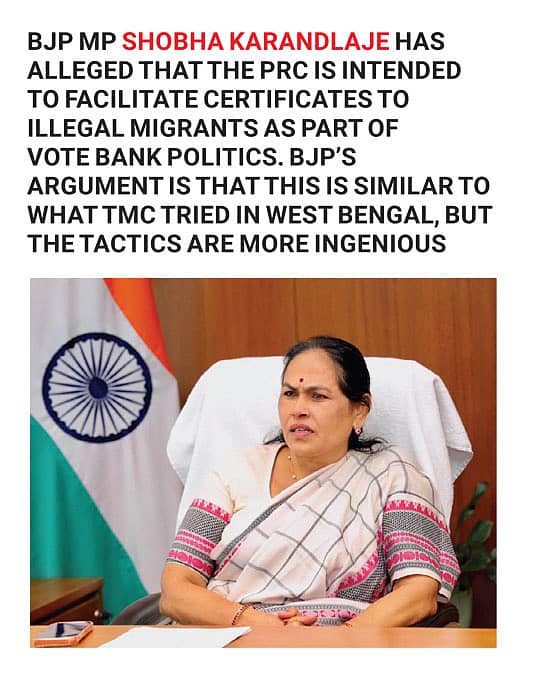
TO THE BHARATIYA JANATA PARTY (BJP), the PRC is a Congress bid to facilitate political laundering of votes. Karandlaje wrote to Home Minister Amit Shah on July 8 asking him to keep the notification in abeyance. “The [PRC] notification raises serious constitutional, legal and national security concerns that require urgent examination by the Union Government,” she wrote. Her first argument is that the Constitution envisages a single citizenship and that a state cannot conjure a separate category of permanent residents by executive notification; the classification, she says, is arbitrary and violates Article 14. Her second is that eligibility rests on local verification by revenue authorities without mandatory citizenship checks by central agencies, so that a person residing unlawfully in Karnataka could use locally acquired or fraudulent records to obtain a certificate and then use it to secure benefits and further documents.
In response, Karnataka Home Minister Priyank Kharge said: “We issue government orders through the established administrative system. We are issuing Permanent Residency Certificates through the government, not through the Congress party.” He did not say how an application resting on local inquiry or oral evidence would be verified.
Meanwhile, BJP and Janata Dal (Secular), or JD(S), have challenged the manner in which SIR forms are being distributed. Union Minister HD Kumaraswamy released video recordings on July 2, claiming they showed the exercise being conducted from a community hall in Ramanagara and at a venue in Kunigal, not through visits to every home. He alleged a scam, accused Congress legislators of pressuring officials, and asked that the exercise be scrapped and begun afresh. State BJP President BY Vijayendra claimed officials were being made to sit inside mosques to complete the process.
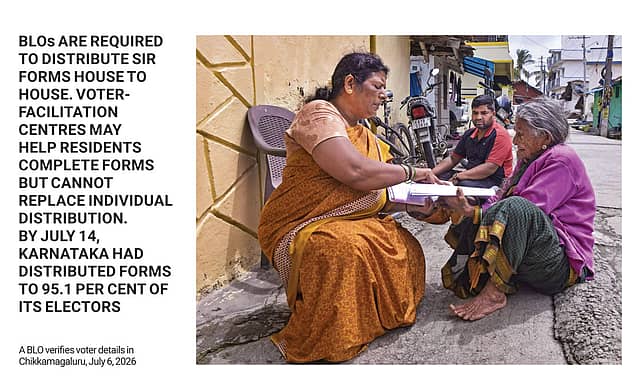
BLOs are required to distribute forms house to house. Voter-facilitation centres may help residents complete forms but cannot replace individual distribution. In response to allegations, Anbukkumar issued fresh instructions on July 2 to enforce door-to-door distribution, and 35 BLOs received show-cause notices for allegedly distributing forms in groups. By July 14, Karnataka had distributed forms to 95.1 per cent of its electors and digitised 36 per cent of them, in an exercise that will finish on July 29.
Adding to the confusion, parts of Bengaluru were enumerated twice. On June 19, three days after the EC froze Karnataka’s Assembly rolls, the Karnataka State Election Commission ordered its own intensive ward-level revision in 27 wards of the Mahadevapura and Gandhinagar Assembly constituencies, ahead of elections to the five corporations under the Greater Bengaluru Authority. It froze its ward rolls as of April 18 and ran its enumeration from June 26 to July 4, overlapping the EC’s exercise, which began on June 30. Its draft roll was due on July 9 and its final roll on July 31, five days before the EC publishes its draft. Congress functionaries had alleged thousands of bogus or duplicate entries, including large numbers of voters registered in tiny commercial premises. BJP, which supports the national SIR, objected to the smaller exercise as selective and politically directed, and asked the EC to halt it under Article 324.
On July 8, the Karnataka High Court issued notice to the State Election Commission, the EC and the state government on a petition challenging the June 19 order. The irony is that Congress leaders who fear exclusion under the EC’s statewide exercise support exceptional scrutiny in Mahadevapura and Gandhinagar, where Congress alleges that irregularities in the existing rolls benefited BJP. BJP, which celebrates SIR nationally, sees danger when a Congress-governed state creates a parallel revision or a new document intended to protect residents. Each side speaks of the purity of the roll. Each suspects purification most when the rival controls the machinery behind it. What is at issue is not verification but who does the verifying.
For More News Updates Follow Us On www.tconews.in