
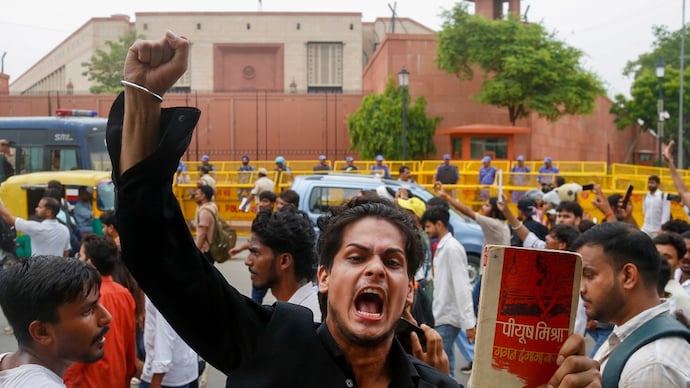
 Cockroach Janta Party held a march towards the Parliament on the first day of the Monsoon session of the Parliament. (Image: PTI)
Conventional wisdom says the Modi government never gives in to pressure. It has cultivated an image of decisiveness, of never allowing the Opposition or street protests to dictate either policy or personnel. On the face of it, therefore, the demand for Dharmendra Pradhan's resignation appears destined to meet the same fate as countless others before it.
And yet, I wouldn't be surprised if Pradhan's tenure as Education Minister is now under more serious threat than many of us realise. Not because students are protesting or because the Opposition is demanding his head, but because the political costs of retaining him may suddenly have become greater than the costs of letting him go.
The first reason is that this government, contrary to popular perception, does retreat when political necessity demands it. It doesn't do so often, and it rarely admits that it has blinked, but history suggests that realpolitik invariably trumps rhetoric.
The farm laws were infamously withdrawn after months of insistence that they would not be. More recently, the Centre recalibrated its approach to the UGC Bill amid concerns over its political implications in the upcoming Uttar Pradesh polls. Neither decision was presented as a surrender; both were justified on the government’s own terms. But they served as reminders that the Modi government is not immune to political arithmetic.
If it believes the costs of holding a position outweigh the benefits, it is perfectly capable of changing course.
The second, and perhaps more compelling, reason is that governments are rarely afraid of protests by themselves. They are afraid of what protests can become. This government has weathered demonstrations far larger than the ones we are witnessing now.
It has shown little inclination to bend before public outrage, celebrity interventions or middle-class anger on social media. What changes the equation is when a protest begins to alter political alignments. That appeared to happen on Monday.
Rahul Gandhi threw his unequivocal support behind the agitation. Mamata Banerjee and Arvind Kejriwal, both looking for issues around which to rebuild political momentum, have embraced it enthusiastically. An Opposition that had looked disorganised after recent electoral setbacks suddenly has a cause capable of uniting disparate parties inside and outside Parliament. Whether that unity lasts is another matter. But from the BJP’s perspective, the possibility itself is reason enough for concern.
The timing could scarcely have been worse. Amit Shah and the BJP leadership had spent months, if not years, preparing for a parliamentary session that was expected to be dominated by legislation that could define this government’s legacy for decades to come.
Delimitation, women's reservation and other significant constitutional and political reforms were expected to dominate the conversation. Getting to this point had required painstaking political management – from allegedly engineering defections in AAP and TMC to persuading opposition satraps like Sharad Pawar and MK Stalin to at least remain neutral on key pieces of legislation.
Yet, by the end of the first day of the Monsoon Session, the government’s legislative agenda had been completely eclipsed. Parliament, television studios and social media were talking about cockroaches, student protests and Dharmendra Pradhan. This is a government that invests enormous effort in narrative management. Losing control of the opening day of a crucial parliamentary session is not something it would have taken lightly.
That, in turn, creates another problem. The very regional parties whose tacit support the BJP may require for some of its legislative ambitions are now being nudged towards siding with the protesters instead.
The comments made by Supriya Sule and MK Stalin following the police action against students were hardly those of parties preparing to quietly assist the government in Parliament. Public statements do not always translate into parliamentary behaviour, but politics is often about creating room for manoeuvre.
Every day that the issue remains alive makes it harder for these parties to be seen cooperating with the government, and that inevitably complicates the BJP's parliamentary calculations.
It is against this backdrop that Monday's meetings become politically interesting. Amit Shah spent three-and-a-half hours with Dharmendra Pradhan. At almost the same time, Union Health Minister JP Nadda met representatives of the CJP. Nobody outside those rooms knows what was discussed, and it would be irresponsible to pretend otherwise.
But long meetings during moments of political crisis usually indicate that the leadership believes there is a political problem requiring careful management. There is no proof that Pradhan has been asked to resign. They are proof that the matter has reached the highest levels of the BJP.
Finally, there is something more intangible but equally significant. I have struggled to find anyone who is actually making a political case for Dharmendra Pradhan anymore. The government's critics want him gone, which is hardly surprising. But more strikingly, even its supporters privately concede that he should probably have been replaced long ago. Their argument is not that he deserves to stay, it is that removing him now would amount to rewarding protests.
That is an important distinction. Once conversations within a political ecosystem shift from defending a minister to debating the timing of his exit, it is usually a sign that his political capital has been substantially depleted. The only question that remains is whether the leadership believes retaining him projects strength or whether it has become an unnecessary political burden.
I may be wrong. Politics has a habit of humbling anyone who makes predictions with too much confidence. But taken together, the sequence of events over the last 48 hours suggests that this story is no longer just about an Education Minister facing criticism over student unrest.
It is about a government trying to prevent one minister from becoming the face of a political crisis that threatens to consume a parliamentary session it had hoped would be remembered for entirely different reasons.
For More News Updates Follow Us On www.tconews.in