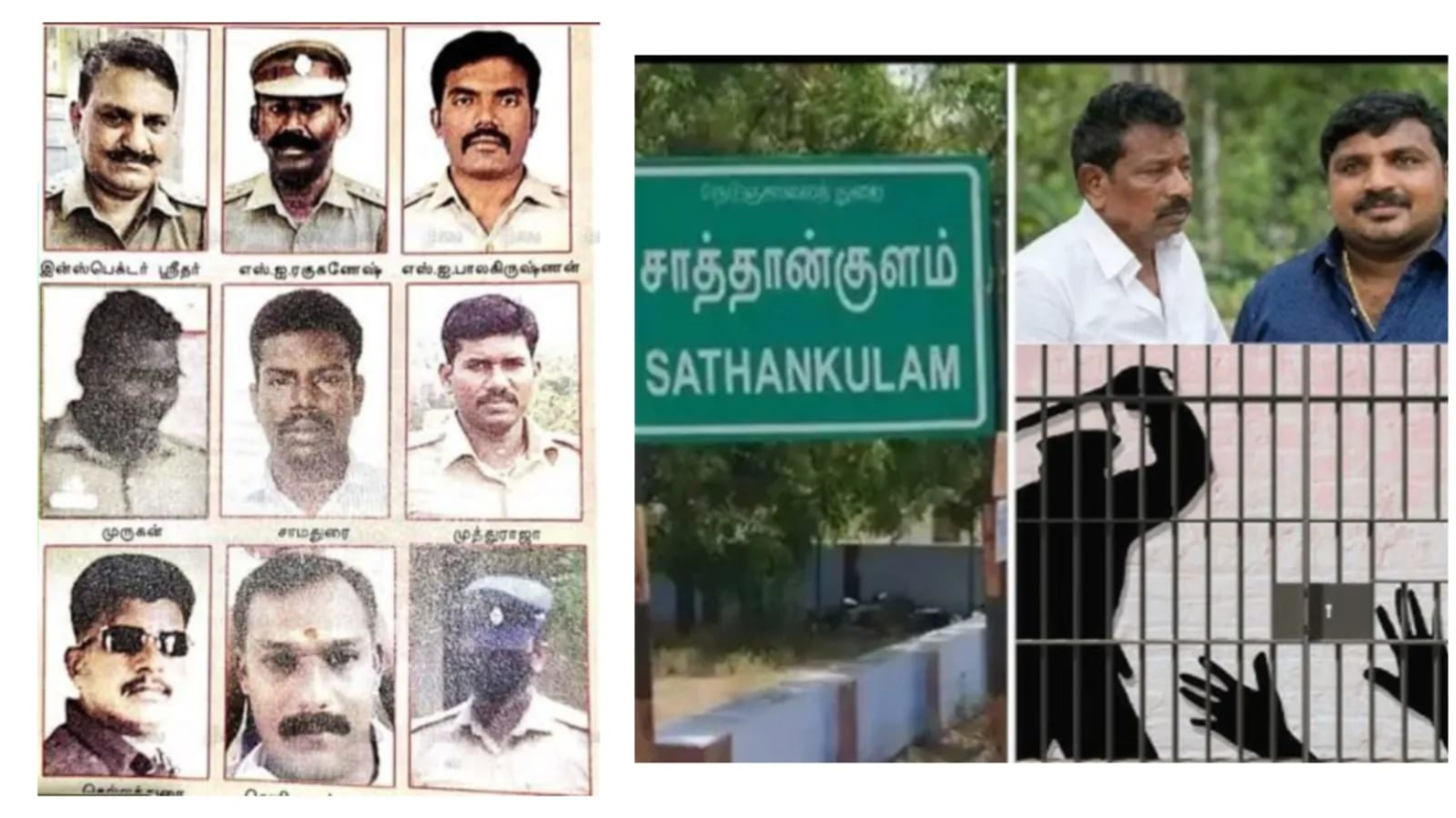
Madurai, Tamil Nadu, April 8, 2026 — In a verdict described as unprecedented in the state’s legal and policing history, the First Additional District and Sessions Court in Madurai on April 6, 2026, sentenced nine Tamil Nadu police personnel to death for the brutal custodial torture and murder of trader P. Jayaraj (aged around 59-60) and his son J. Bennix (aged 31) in June 2020.
Presiding Judge G. Muthukumaran termed the case a “rarest of rare” instance of gross abuse of power, stating that the officers — entrusted with upholding the law — had instead become “violators of law and constitutional responsibilities” by turning killers. The court convicted all nine accused of murder and related offences, rejecting defence claims that the deaths resulted from pre-existing conditions or self-inflicted injuries. In addition to the capital punishment, the convicts were ordered to pay a collective compensation of ₹1.40 crore to the victims’ family.
The judge symbolically broke the nib of his pen after pronouncing the sentence, a traditional gesture underscoring the finality of the death penalty.
# The 2020 Incident: A Minor Lockdown Violation Turns Fatal
The tragedy unfolded on the evening of June 19, 2020, at the height of the COVID-19 lockdown in Sathankulam town, Thoothukudi (Tuticorin) district. Jayaraj, a mobile phone shop owner, and his son Bennix, who ran a nearby mobile accessories stand, were arrested by officers from the Sathankulam police station for allegedly keeping their shop open 15 minutes past the permitted trading hours — a minor violation of lockdown rules.
What began as a verbal altercation escalated horrifically. Sub-Inspector K. Balakrishnan and other officers took Jayaraj into custody around 7:45 pm. When Bennix arrived at the station to check on his father, he too was detained after witnessing the assault. From approximately 7:45 pm until 3 am the next morning, both men were subjected to sustained third-degree torture inside the locked police station. Eyewitness accounts and later evidence described repeated beatings with batons and kicks, stripping of their clothes, and rectal assault with batons — acts that caused severe internal injuries, including profuse rectal bleeding and a punctured lung.
On June 20, the duo was produced before a magistrate and remanded to judicial custody at Kovilpatti sub-jail, about 100 km away. Despite visible injuries and medical certificates noting bleeding, they were not provided immediate proper treatment. Bennix succumbed to internal bleeding on June 22 at Kovilpatti Government Hospital. Jayaraj died the following morning, June 23, from complications including pneumothorax (punctured lung). Post-mortem examinations, conducted under judicial supervision and video-recorded, confirmed the injuries were unnatural and consistent with brutal assault.
# Nationwide Outrage, Judicial Intervention and CBI Probe
The deaths sparked immediate protests by local traders on June 23, which quickly spread across Tamil Nadu. The case drew national and international attention, with #JusticeForJayarajAndBennix trending widely on social media. Celebrities, politicians, and activists condemned the incident, with some likening it to the George Floyd case in the United States. Opposition leaders, including then-DMK chief M.K. Stalin, demanded a CBI inquiry.
The Madurai Bench of the Madras High Court took suo motu cognisance on June 24-25, 2020, with Justices P.N. Prakash and B. Pugalendhi directing an inquiry and later transferring the case to the CBI for an independent probe — an extraordinary step. The court also ordered the district collector to seize control of the Sathankulam police station (a first in Indian policing history) to preserve evidence. Forensic experts recovered blood samples from walls and floors that matched the victims’ DNA via scientific analysis. Call data records and witness testimonies, including from a woman head constable who turned approver, further corroborated the torture.
The Tamil Nadu government initially suspended several officers and transferred the entire station staff. The CBI arrested 10 personnel in July 2020 and filed a detailed chargesheet in September 2020 under IPC sections including 302 (murder), 120-B (criminal conspiracy), 342 (wrongful confinement), and others. One accused, Special Sub-Inspector Pauldurai, died of COVID-19 during the trial.
# The Trial and Verdict: A Six-Year Battle for Accountability
The trial, held in a special CBI court in Madurai, began in February 2021 and involved over 100 witnesses. On March 23, 2026, Judge Muthukumaran convicted all nine remaining accused. The sentencing hearing on April 6 delivered the death penalty to each.
The convicted officers are:
- Inspector S. Sridhar (then SHO of Sathankulam PS)
- Sub-Inspectors K. Balakrishnan and P. Raghu Ganesh
- Head Constables S. Murugan and A. Samadurai (also spelled Saamidurai)
- Constables M. Muthuraja (Muthu Raja), S. Chelladurai, X. Thomas Francis, and S. Vailmuthu (Veilumuthu)
The court emphasised that the police had acted with “cold-blooded” intent, abusing their authority against two citizens with no prior criminal record.
# Reactions and Broader Implications
Jayaraj’s daughter Persis, who fought the legal battle alongside her mother for six years, reacted emotionally: “Do they have a licence to kill innocents?” She questioned how the officers — themselves family men — could commit such “beastly behaviour.”
Human rights activist Henry Tiphagne of People’s Watch highlighted Tamil Nadu’s poor record on custodial deaths, noting 32 such cases between 2021-2025 with zero prior convictions. The verdict has been hailed as a potential deterrent against police impunity, though experts caution that death sentences face mandatory High Court confirmation and likely appeals.
The ruling has reignited calls for a comprehensive anti-torture law at the national level (previous bills in 2010 and 2017 lapsed) and stricter implementation of Supreme Court guidelines on arrests and CCTV monitoring in police stations. It stands as a rare instance where an entire police station staff was held collectively accountable for custodial violence.
While the death penalty has drawn some debate on rehabilitative justice, supporters view it as a strong message that “ordinary citizens” would face far harsher scrutiny for similar crimes, as noted by the judge.
The Sathankulam case, once a symbol of unchecked police brutality during the pandemic, now represents a historic judicial reckoning. The verdict’s finality will depend on higher courts, but it has already begun eroding the perception of impunity in custodial settings across India.
For More News Updates Follow Us On www.tconews.in