Karnataka Home Minister Priyank Kharge’s persistent questioning of the Rashtriya Swayamsevak Sangh’s legal status appears to have forced a reckoning of sorts. The organisation's chief Mohan Bhagwat and other senior functionaries have now claimed that these questions were settled decades ago, and are offering “evidence” to that effect.
These statements are only half the story. The rest lies in the RSS’ constitution and has been pieced together by legal scholars and journalists from court filings and documents provided by insiders in the organisation. The picture that emerges is of an organisation designed to evade legal scrutiny. One that Prime Minister Narendra Modi described as the “world’s biggest NGO,” and which functions out of multi-storey buildings worth crores—while claiming that it owns no assets.
Though the RSS has formally acknowledged 36 affiliates, a project by the Science Po’s Centre for International Studies has mapped around 2500 organisations that collectively form the Sangh Parivar network. But little is known about how they fund or mobilise resources for the activities they claim credit for—a pointrecently made by the scholar Felix Pal, who headed the project. Few of the organisations directly affiliated to the RSS are known to have bank accounts in their name even though they claim to carry out social, economic and religious programmes on a massive scale.
For the past year, Priyank Kharge has continually raised questions about the RSS’ legal status and sources of funding, forcing the RSS to respond in November 2025. Recently, he wrote to RSS Sarsangchalak Mohan Bhagwat questioning the organisation’s legal status, accountability, financial transparency, sources of funding and compliance with the Constitution and laws of India.
Priyank Kharge’s letter led to many – from the VHP’s international president Alok Kumar to RSS ideologue S Gurumurthy and former BJP Rajya Sabha MP Mahesh Jethmalani – rushing to the RSS’ defence.
Alok Kumar said on June 16: “Once a year we collect guru dakshina. The Sangh does not collect money from outsiders. Guru dakshina is the income of the shakha that receives it.”
Alok Kumar also said that these questions had been resolved when the Income Tax assessing officers had issued notices to the RSS in 1967-68 and 1975-76. “This was challenged in two places. In both places, the high courts said that on principles of mutuality, income tax is not applicable to guru dakshina,” he said, adding that these rulings were not challenged by any government subsequently.
Mutuality is a concept in tax law which holds that an entity cannot derive profit from itself.
Gurumurthy claimed that he was associated with the handling of Income Tax proceedings against RSS from the 1970s. “As per the RSS constitution individual shakhas are assessable as they are financially independent,” he said.
What Gurumurthy was referring to is the RSS’ submission to the Income-Tax officials. Proceedings launched in the 1970s that culminated in a 1994 Patna High Court judgement which accepted the RSS’ argument that guru dakshinawas exempt under the mutuality principle.
Why is guru dakshina central to RSS funding?
The legal scholar AG Noorani has argued that guru dakshina was given a central place in the RSS’ constitution in the face of proceedings initiated by the Income-Tax Department and by one of its own long-time Nagpur members.
The RSS constitution is a little known document. Its website makes only one mention of it: In the timeline of its history, the RSS notes that 1949 was the year their constitution was drafted. The lifting of the ban on the RSS and release of MS Golwalkar, the organisation’s second Sarsangh Chalak from jail happened the same year.
A copy of its constitution does not appear to be on its website but an undated copy exists on Internet Archive. The document lists out its aims, objectives, membership eligibility, and organisational structure.
RSS constitution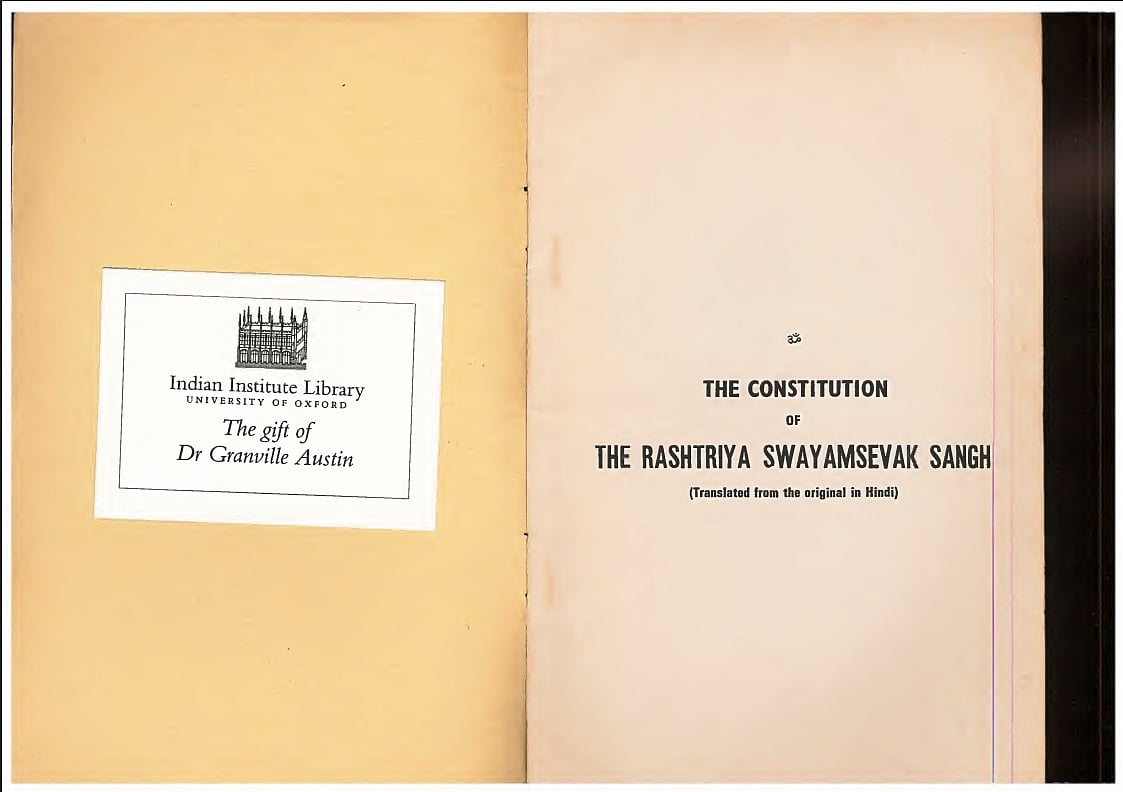
Commentators have argued that the RSS’ constitution owes its existence to the ban on the organisation after the assassination of MK Gandhi. Jawaharlal Nehru and Vallabh Bhai Patel, who were the prime minister and home minister respectively, were wary of lifting the ban despite Golwalkar lobbying for it. Eventually, they insisted that the RSS submit a written constitution that eschewed violence and clearly stated its aims and purposes.
While Gurumurthy claims that there was no such condition, an article by journalist Vidya Subrahmaniam argues that the 1949 ban on the RSS was lifted with the condition that the RSS should have a constitution and reject “secrecy and violence,” show “respect to the Indian flag,” and adopt a “non-political, cultural role”.
Accordingly, the RSS submitted a constitution to Vallabh Bhai Patel in 1949. Under the policy section, the document states that the “Sangh believes in orderly evolution of the society and adheres to peaceful and legitimate means for the realisation of its ideals,” and that it has “abiding faith in the fundamental principle of tolerance towards all faiths.”
It also says that the Sangh, “as such, has no politics and is devoted purely to cultural work” but that individual swayamsewaks were free to join any party as long as those organisations espoused non-violence, and that people espousing violence would have no place in the Sangh.
The 1949 document also says that each shakha is to maintain a register of swayamsevaks, whether active or not. A swayamsevak was simply a Hindu male above the age of 18 who took the RSS pledge and followed its rules. There was also a provision for bal swayamsevaks, any Hindu male below the age of 18.
RSS constitution 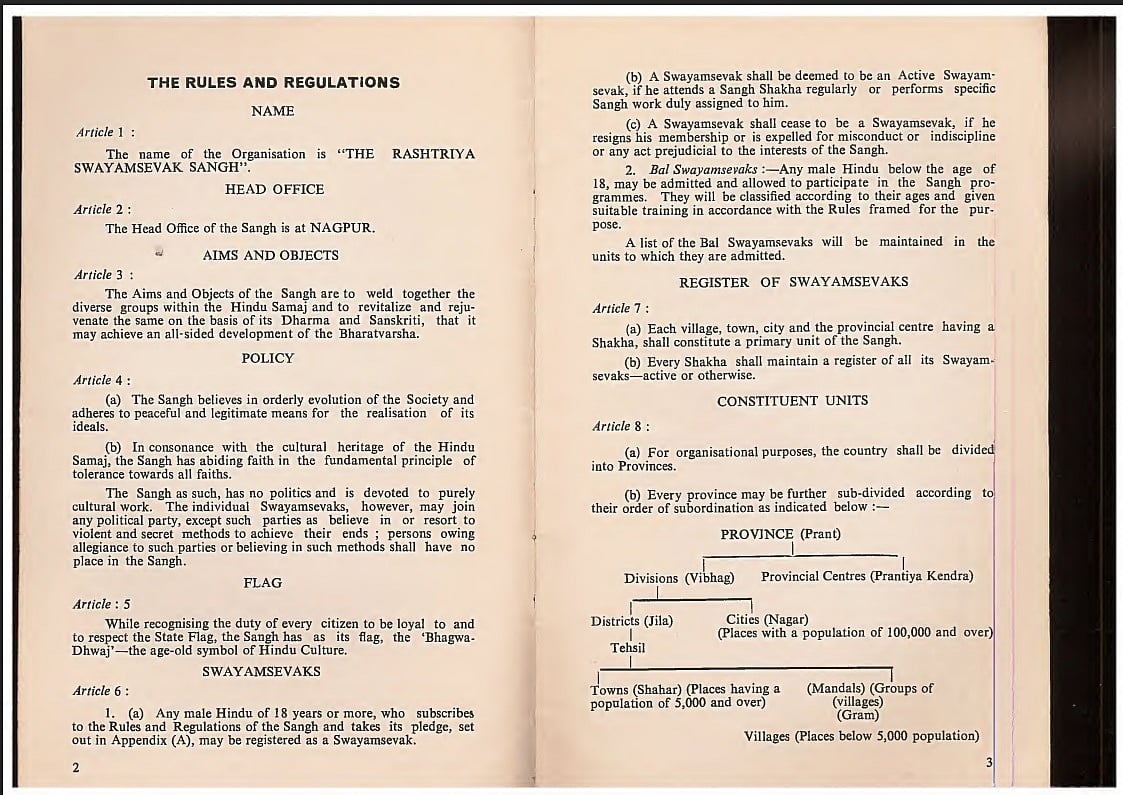
The RSS’ 1949 constitution is included in the 1979 book Rashtriya Swayamsevak Sangh by DR Goyal and is reproduced by the legal scholar and lawyer AG Noorani in his book The RSS: A Menace to India published in 2019. A chapter in the book is dedicated to the troubles RSS had with Maharashtra’s Charity Commissioner and the Income Tax Department in the 1970s-80s. Before that, he also touched on some aspects of these proceedings in a 2006 article for Frontline magazine.
Noorani notes that MD Kamdar, an RSS member of 30 years in Nagpur, alleged that the RSS had a constitution since 1933. Kamdar, according to Noorani, also said that the claim made in the document submitted to Patel – that the RSS had so far not had a constitution – was false. In the 1970s, Kamdar initiated legal proceedings to get the RSS registered as a public trust under the Bombay Public Trusts Act.
Kamdar also alleged that the 1949 constitution was amended in 1972 to give a legal status to the ‘Guru Dakshina’ among other things.
A copy of the amended constitution cannot be found online, but Noorani quotes it from documents provided to him by Kamdar. Official Income Tax documents provided by Kamdar and cited in Noorani’s book corroborate that the RSS did amend its constitution in 1972.
Joint Charity Commissioner MS Vaidya’s observations, while he presided over Kamdar’s complaint, point to curious behaviour on the part of the RSS—the constitution its functionaries submitted to the government did not mention the date on which it was adopted, not even the date of printing or publishing.
Vaidya said, “It is indeed, not known why the Respondent (RSS leader) failed to bring on record a copy of the constitution containing up to date amendments. The allegation of the applicant appellant (Kamdar) that the respondents (RSS) want to be secretive in the matter of certain particulars about the constitution gains ground due to this omission and also the production of documents, Exhs. 23 and 47 (the final version submitted by the RSS) which bear no date or final adoption of the constitution, not even the date of typing or printing and publishing.”
According to Noorani’s book, before the 1972 amendment, Section 5 of the RSS constitution said, “While recognising the duty of every citizen to be loyal to and to respect the state flag, the Sangh has its flag, the ‘Bhagwa Dhwaj’ the age-old symbol of Hindu Culture.”
After the amendment, the same provision read, “While recognising the duty of every citizen to be loyal to and to respect the state flag, the Sangh has as its flag the ‘Bhagwa-Dhwaj’ the age-old symbol of Hindu culture, which the Sangh regards as its Guru.’ (emphasis added)
The organisation’s 1949 constitution said in Article 22: ‘All offerings, gifts, donations, etc. received for Sangh purposes by the branches, shall constitute the Sangh Funds.’
The amended provision said, ‘The guru dakshina’ received for Sangh purposes by a Sangh shakha, shall ‘constitute the funds of that Shakha’.’
The result of the amendment, Noorani says, was that “Tax liability was passed on to each shakha. These amendments were made on legal advice and during the litigation.”
Noorani noted that the amended constitution was submitted to the Income Tax officer of Central Circle 3, Nagpur. “On 31.10.1973, an amended constitution of the Rashtriya Swayamsevak Sangh was also filed before me. It was stated that the constitution of RSS was amended on 1.7.1972 and the proposals for amendment come from the Karnataka Prantiya Karyakari Mandal. On 21.11.72 the assessee filed a note reiterating that: ‘All the shakhas are independent units by themselves. They have their own executive bodies, they receive guru dakshina from Swayamsevaks and they are free to utilise the same in the manner they like keeping in view the ideals of the Sangh. There is nothing like head office nor there is anything like branches’,” the officer said.
However, the officer noted that the RSS had made contradictory claims at different points of time. On some occasions, the Sangh had said that it can call for funds from its shakhas, but on others it denied any such action. The officer also noted that the books of the Nagpur prant “clearly indicate that the Gurudakshina collected by various small shakhas was in the year under consideration, passed on to the prant office… All this leads me to the irresistible conclusion that the organisation is one as a whole and therefore, I hold that the income earned by the shakas, the Zilla office, and the prant offices would definitely be taxable in the hands of the organisation which I am assessing through its Central office.”
For the RSS, prant is a geographical and administrative unit.
The proceedings continued and it is unclear what happened to them. Noorani himself was unable to ascertain the conclusion of these proceedings but says that the RSS leaders’ filings before the Income-Tax Department and before the charity commissioner of Maharashtra were indicative of its “mendacity”.
What is the RSS?
Although the RSS may have won a favourable ruling regarding the payment of income tax, the proceedings initiated by MD Kamdar forced the RSS to describe itself, its activities and philosophy. “What emerged in the long-drawn out litigation was the RSS’ proneness to lie and to deceive,” Noorani wrote.
He then outlined the contradictory statements that the Sangh had made. To the Income-Tax Department and later in the Bombay High Court, the RSS claimed that it was a charitable institution under Section 10(22) of the Income Tax Act, 1961. But it claimed the opposite before the Charity Commissioner to whom it said that it was not a charitable trust but a political institution under Section 2(13) of the Bombay Public Trusts Act, 1950.
Up to 1999, Section 10(22) of the I-T Act exempted educational institutions existing solely for educational purposes and not for profit, from paying income tax. Such institutions could be run by any entity, such as individuals, an association of persons, firms, companies etc. This provision was widely misusedin the absence of any monitoring mechanism for checking the genuineness of these claims and was omitted in 1998 by an amendment to the law. Section 2(13) of the Bombay Public Trusts Act defines the term Public Trust.
The Income-Tax Department rejected the RSS’ claim that it was purely an educational and cultural charitable body. “If the assessee has to work for the rejuvenation of the Hindu Society arising from political differences, the political purpose cannot be avoided,” Noorani quotes the IT officers as saying in Frontline.
This political purpose, Noorani pointed out, is glaringly evident in the appeal filed before the Nagpur district court by the then Sarsanghachalak Rajendra Singh and RSS ideologue Bhaurao Deoras in the Nagpur district court in 1978. They filed the appeal when the Joint Charity Commissioner MS Vaidya ruled that the RSS was a public religious charitable trust. The entire appeal can be read in Noorani’s book.
Rajendra Singh and Bhaurao Deoras claimed that “the work of the RSS is neither religious nor charitable but its objects are cultural and patriotic… It is akin to political purposes though RSS is not at present a political party in as much as the RSS constitution quoted above bars activities political participation by RSS as such as a policy.”
The appeal also said that the festivals observed by the RSS, such as Hindu Samrajya Din, Dussera and others have “a political and social connotation for inspiring in the Swayamsevaks the dream of Hindu Rashtra on (sic) the fact that in historical past such a dream was visualised and fulfilled and as such one could do so again by organising the Hindu society…”
Elsewhere in the appeal memo, they explained: “The concept of `Hindu nation' of the founder RSS was on the basis of cultural unity of the entire people living in the Bharat Varsh… It is significant to note that the name was not chosen as `Hindu Swayamsevak Sangh' though the Sangh is open to Hindus only. This is because of the faith of the Sangh that in India `Rashtriya' (national) means `of Hindus' which are the mainstream of the Nation.”
The RSS set up the Muslim Rashtriya Manch only in 2002, the year that the Gujarat pogrom was carried out.
The appeal memo spoke at length of the RSS’ vision which did not include politics at the time but did not rule out the possibility. “Tomorrow the policy could be changed and RSS could participate in even day to day political activity as a political party because policy is not a permanent or irrevocable thing… The RSS desires to dominate the world by cultural conquest by a great process of true national regeneration.”
How Kharge has been upping the ante
Although Priyank Kharge has consistently taken on the RSS, he has upped the ante since he recently took charge of Karnataka’s Home Department. On June 15, he released on X a letter he wrote to RSS chief Mohan Bhagwat, seeking answers to these questions.
Citing the RSS’ latest annual report, which claimed that they held over 2,000 Samajotsavas and 562 route marches in Karnataka, Priyank said, “... these figures show a vast, disciplined and deeply embedded network operating across Karnataka through daily cadre-building, weekly and months outreach, mass public events and uniformed route marches”.
He continued: “Such an extensive organisational presence… cannot be treated as a private or informal arrangement. It raises legitimate questions about legal status, accountability, financial transparency, public order, permissions, sources of funding and compliance with the Constitution and laws of India.”
The letter then went on to “request” the RSS to “depute its authorised office bearers to explain the legal grounds on which an organisation of such magnitude continues to function with anonymity and without being formally registered as a legal entity or as a ‘body of individuals’ under the applicable laws.”
As a political debate rages around these questions, Priyank Kharge has dug his heels in. Speaking to reporters on June 17, Priyank sarcastically said, “We’ll give them time… It’s a 100 year-old organisation. They must be looking for the documents. They will also need time.”
But on a more serious note he said, “If they don’t reply, then that’s as good as saying no to a government query, you’re saying no questions asked by the government and yet you want to function in my state? Then I’m sorry… Nobody is above the law. It has nothing to do with the RSS. If any organisation wants to do social, cultural, economic work or politics on such a scale, let them register and do it… The constitution gives you the right to do it, but tell who you are, where you get your money from and what you want to do. You do your work on donations. In a country where the Ram temple trust in Ayodhya temple is facing allegations of irregularities in the donations, shouldn’t we ask these people who are doing politics in the name of Ram, for their accounts?... I will send them reminders, if they don’t respond, the government will do what it has to do within the framework of the law.”
For More News Updates Follow Us On www.tconews.in