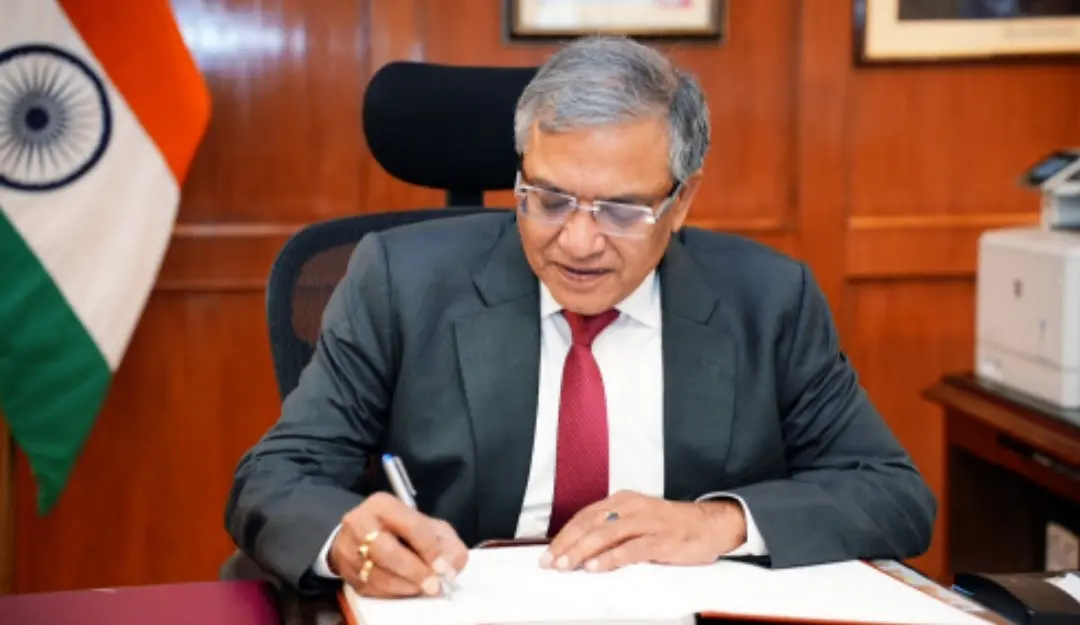
 Chief Election Commissioner Gyanesh Kumar
The demand for action against Chief Election Commissioner Gyanesh Kumar has moved from political rhetoric to a sharper constitutional question: even if the government wanted him out of office, how could it legally remove a sitting CEC?
The question has acquired urgency after a report by TheIndian Express revealed that Election Commissioners Sukhbir Singh Sandhu and Vivek Joshi had formally objected at least 14 times over 10 months to decisions and orders concerning electoral-roll management and the Special Intensive Revision (SIR).
Their objections reportedly covered voter registration, deletion and restoration of names, changes to Form 6 and the handling and security of electoral-roll databases.
The Election Commission, however, has rejected the suggestion that the reported differences indicate unilateral decision-making.
It has maintained that differing observations are part of institutional deliberations and that decisions taken by the full Commission, including those relating to SIR, were unanimous.
Opposition leaders have renewed demands for Kumar's removal, with some also calling for his arrest. But a political demand and a constitutionally valid removal are two very different things.
Why can’t the government simply remove the CEC?
The starting point is Article 324(5) of the Constitution. It gives the Chief Election Commissioner a level of removal protection comparable to that enjoyed by a Supreme Court judge.
The 2023 Chief Election Commissioner and Other Election Commissioners Act also incorporates the same standard through Section 11.
That means the Union government cannot simply issue an order dismissing the CEC.
The constitutional route is tied to the grounds applicable to a Supreme Court judge, namely proved misbehaviour or incapacity.
The procedure ultimately requires action by both Houses of Parliament and an order from the President.
The steps required to remove Gyanesh Kumar are:
- A removal motion must be initiated in Parliament: Under the procedure applicable to removal of a Supreme Court judge, such a motion requires the prescribed number of parliamentary signatures, at least 100 Lok Sabha members or 50 Rajya Sabha members.
- The motion must be admitted by the presiding officer: The Speaker of the Lok Sabha or Chairman of the Rajya Sabha can admit or refuse the motion.
- An inquiry committee examines the allegations: If the motion is admitted, a three-member committee is constituted under the Judges (Inquiry) Act framework. It comprises a Supreme Court judge, a Chief Justice of a High Court and a distinguished jurist.
- The allegations must be established: The committee examines whether the charges amount to proved misbehaviour or incapacity.
- Both Houses must approve the removal address: Each House must pass the address by a majority of its total membership and by at least two-thirds of the members present and voting. The approval must take place in the same parliamentary session.
- The President issues the removal order: Only after the required parliamentary address is presented to the President can an order removing the CEC be issued.
The threshold is therefore considerably higher than a simple parliamentary resolution or a demand from the Union government.
What does the Section 16 controversy mean for Kumar?
The separate controversy concerns Section 16 of the 2023 Act, which deals with protection for the CEC and Election Commissioners.
The provision was not part of the original Bill introduced in August 2023.
During Rajya Sabha consideration on December 12, 2023, then Law Minister Arjun Ram Meghwal moved Amendment No. 39 to insert a new Clause 15A providing protection against civil and criminal proceedings for acts, things or words connected with the discharge, or purported discharge, of official duty.
The amendment was adopted and ultimately became Section 16 of the enacted law.
Its wording is significant because it refers to a person who ‘is or was’ a CEC or Election Commissioner. It also says that no court shall entertain or continue civil or criminal proceedings for conduct covered by the provision and connected with official functions.
However, Section 16 does not expressly say that a CEC cannot be arrested. It does not use the words ‘arrest’, ‘police investigation’ or ‘investigation’.
Its express language concerns whether courts can entertain or continue specified civil or criminal proceedings.
That distinction matters in the current controversy. A statutory protection from specified court proceedings cannot automatically be described as a blanket immunity from arrest.
The Supreme Court is also examining the constitutional challenge to Section 16.
In January 2026, the court agreed to hear a petition filed by Lok Prahari challenging the provision and issued notice to the Centre and the Election Commission, while declining to stay it. The court has not yet delivered a final judgment on its validity or precise scope.
Meanwhile, the political controversy stems from the reported objections by Sandhu and Joshi.
The Indian Express reported that the two commissioners had raised concerns on multiple occasions about matters including Form 6, voter-roll data and decisions allegedly taken without their knowledge.
The Election Commission has presented a different account, saying such observations were part of the drafting and deliberative process and insisting that the final decisions of the Commission were unanimous.
Therefore, the present dispute does not itself establish that Kumar committed ‘proved misbehaviour’ or any criminal offence.
Those are legal questions requiring the applicable constitutional and statutory processes.
For now, the legal position is clear on one central point: the government cannot simply dismiss a sitting Chief Election Commissioner.
Removing Kumar would require the constitutionally prescribed process applicable to a Supreme Court judge, including an inquiry into the allegations, approval by both Houses of Parliament with the required special majority, and ultimately an order from the President.
Section 16 raises a separate question about the extent of protection available to a serving or former Election Commissioner for acts connected with official duties.
That provision remains in force while its constitutional validity and scope are under judicial scrutiny.
For More News Updates Follow Us On www.tconews.in