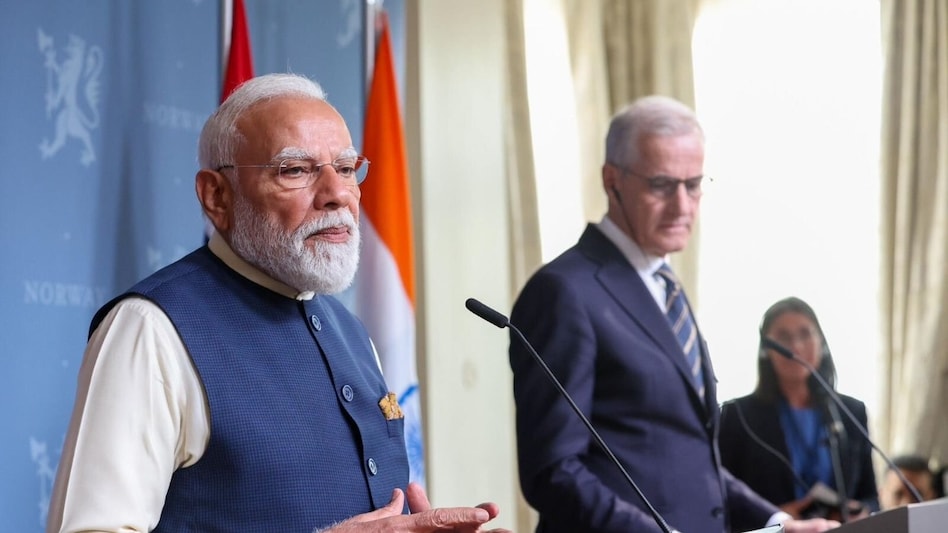
 The MEA said in its reply that high-level visits by the PM are an established means of fostering closer relations with foreign countries and promoting India's engagements at the bilateral, regional and global levels.
India spent ₹482.92 crore on Prime Minister Narendra Modi's foreign visits between 2021 and 2025, while receiving $381.8 billion in Foreign Direct Investment (FDI) during the April 2021-December 2025 period, according to information tabled in the Rajya Sabha. At an exchange rate of ₹83 per US dollar, the FDI inflows translate to nearly ₹31.69 lakh crore.
A comparison of the two figures indicates that for every ₹1 spent on the Prime Minister's overseas visits, India received roughly ₹65,000-66,000 in FDI over the period. However, this is only a mathematical comparison and should not be interpreted as evidence that the foreign visits directly resulted in the investment inflows. The government has not established or claimed any direct link between the two.
Foreign visit expenditure
The expenditure on the Prime Minister's overseas engagements has risen steadily as India's diplomatic engagements expanded after the pandemic.
According to the data, the government spent ₹36.12 crore on three foreign visits in 2021. The expenditure increased to ₹55.83 crore across seven visits in 2022, followed by ₹93.63 crore for six visits in 2023. Spending crossed the ₹100-crore mark in 2024, reaching ₹109.51 crore across 11 visits, before rising further to ₹187.83 crore in 2025, also covering 11 overseas engagements.
Foreign visit expenditure
The expenditure on the Prime Minister's overseas engagements has risen steadily as India's diplomatic engagements expanded after the pandemic.
According to the data, the government spent ₹36.12 crore on three foreign visits in 2021. The expenditure increased to ₹55.83 crore across seven visits in 2022, followed by ₹93.63 crore for six visits in 2023. Spending crossed the ₹100-crore mark in 2024, reaching ₹109.51 crore across 11 visits, before rising further to ₹187.83 crore in 2025, also covering 11 overseas engagements.
For 2026, the government has disclosed expenditure of about ₹74.59 crore so far. However, these figures remain provisional as the expenditure for the France leg of the June visit is still being compiled, while several other country-wise expenses are subject to final settlement of bills.
| Year | Foreign Visits | Expenditure (₹ crore) | FDI Inflows |
| 2021 | 3 | 36.12 | Not provided separately |
| 2022 | 7 | 55.83 | Not provided separately |
| 2023 | 6 | 93.63 | Not provided separately |
| 2024 | 11 | 109.51 | Not provided separately |
| 2025 | 11 | 187.83 | Not provided separately |
| 2026* | 6 | 74.59* | Not available (2026 period not covered) |
| Apr 2021–Dec 2025 | 38 visits | ₹482.92 crore | USD 381.8 billion (total FDI received) |
₹ 1 spent vs ₹ 66,000 in FDI
Based on the government's data, India received USD 381.8 billion in FDI between April 2021 and December 2025, which translates to approximately ₹31.69 lakh crore at an assumed exchange rate of ₹83 per US dollar.
During the same period, the government spent ₹482.92 crore on Prime Minister Narendra Modi's foreign visits. On a simple mathematical comparison, this works out to about ₹65,620, or roughly ₹66,000 in FDI for every ₹1 spent on overseas visits. However, this is only an illustrative ratio and should not be interpreted as evidence that the foreign visits directly resulted in the investment inflows, as the government has made no such claim.
| Particulars | Calculation | Value |
|---|---|---|
| Total FDI received (Apr 2021–Dec 2025) | As reported by the government | USD 381.8 billion |
| Assumed exchange rate | 1 USD = ₹83 | ₹83/USD |
| FDI in Indian Rupees | USD 381.8 billion × ₹83 | ₹31.69 lakh crore (≈ ₹31,689,400 crore) |
| Total expenditure on PM's foreign visits (2021–2025) | Sum of annual expenditure | ₹482.92 crore |
| FDI received per ₹1 spent on foreign visits | ₹31,689,400 crore ÷ ₹482.92 crore | ≈ ₹65,620 |
| ≈ ₹66,000 of FDI for every ₹1 spent |
Trade and investment ties
The Ministry of External Affairs (MEA) said in its reply that high-level visits by the Prime Minister are an established means of fostering closer relations with foreign countries and promoting India's engagements at the bilateral, regional and global levels.
According to the government, these visits and the agreements concluded during them facilitate partnerships across a broad range of sectors, including technology, innovation, trade and investment, defence, energy cooperation and resilient supply chains. The reply also includes country-wise details of Memoranda of Understanding (MoUs) signed during the visits.
PM visits and MOUs
The government informed Parliament that PM Modi's foreign visits since 2021 have resulted in a wide range of Memoranda of Understanding (MoUs) aimed at strengthening India's strategic, economic and technological partnerships. The agreements span sectors including artificial intelligence, digital technologies, renewable energy, defence, healthcare, agriculture, space, skill development, critical minerals, semiconductors, telecommunications and digital public infrastructure such as UPI. Key partnerships were signed with countries including France, Australia, Germany, Indonesia, Brazil, Bhutan, Cyprus, Ethiopia and Guyana, among others.
Several agreements also focus on startup collaboration, research, mobility, nuclear cooperation, green hydrogen and digital transformation. According to the government, these engagements support stronger bilateral ties and create long-term opportunities for trade, investment, innovation and technology cooperation.
| Country | Key Areas of Cooperation / MoUs | Year(s) |
| France | AI governance, Innovation Roadmap 2030, UPI expansion, digital sciences, startups, railways, healthcare, nuclear energy, space, trade, digital technologies | 2023, 2025, 2026 |
| Indonesia | Defence (BrahMos, air-to-air missiles), telecommunications, steel supply chain, agriculture, health, minerals, R&D, outer space | 2026 |
| Germany | Green hydrogen, renewable energy, migration, biosafety, research, skill development, occupational safety | 2022 |
| Australia | Mining technology, geoscience, skills development, mobility & migration | 2023, 2026 |
| Brazil | Renewable energy, agriculture, digital public infrastructure, intellectual property, cybersecurity | 2025 |
| Bhutan | Renewable energy, health, petroleum supply, food safety, sports, space, education | 2024–2025 |
| Guyana | UPI-like digital payments, healthcare, agriculture, hydrocarbons, broadcasting, defence education | 2024 |
| Cyprus | UPI payments, stock exchange cooperation, Indian studies | 2025 |
| Ethiopia | Data centre, customs cooperation, UN peacekeeping | 2025 |
| Egypt | Strategic partnership, agriculture, heritage conservation, competition law | 2023 |
| Croatia | Science & technology, agriculture, cultural exchange, Hindi chair | 2025 |
| Brunei | ISRO satellite tracking and telemetry cooperation | 2024 |
| Ghana | Standards, Ayurveda, cultural exchange | 2025 |
| Greece | Agriculture cooperation | 2023 |