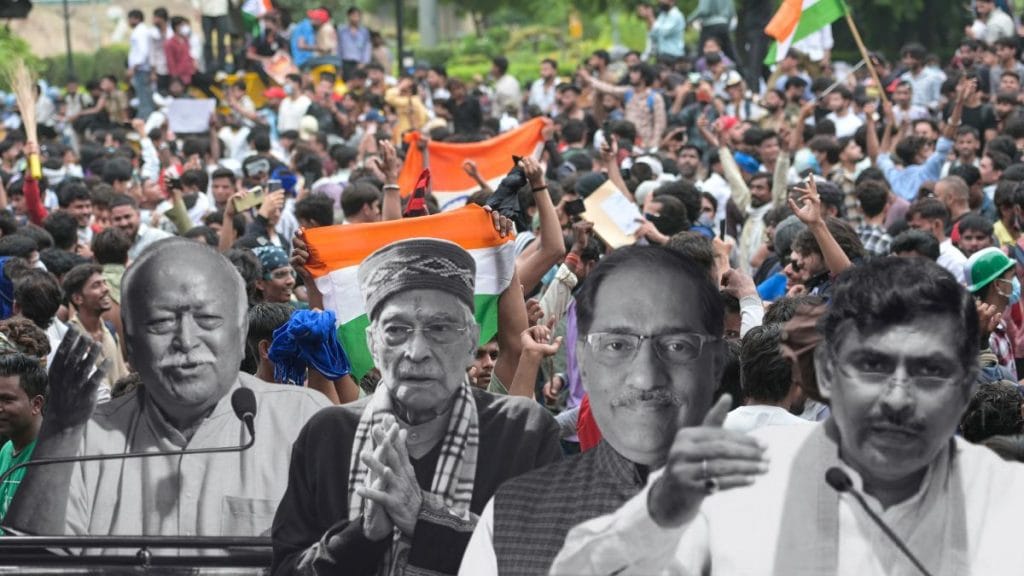
File photo of young protesters celebrating after Education Minister Dharmendra Pradhan submitted his resignation; from left: RSS chief Mohan Bhagwat, senior BJP leaders Murli Manohar Joshi, Sangh ideologue Ratan Sharda | Suraj Singh Bisht/ThePrint/ANI
New Delhi: As the dust settles over the youth protest that took over the country over the past few weeks, a few prominent—and seemingly discordant—voices from the Rashtriya Swayamsevak Sangh (RSS) have emerged.
Experts viewed the statements from various leaders as both critiquing and advising the Bharatiya Janata Party (BJP) to course-correct.
From RSS chief Mohan Bhagwat to veteran BJP leaders and swayamsevaks Murli Manohar Joshi and Muralidhar Rao, as well as Sangh ideologue Ratan Sharda, senior Sangh leaders seemed uncomfortable with the way the government dealt with young protesters.
Last week, without referring to the young protesters, Mohan Bhagwat spoke about how the new generation asks questions and demands logic. He urged people to engage in dialogue with them instead of giving them orders.
Speaking at the valedictory session of a two-day national meeting on ‘Contemporary Motherhood’, Bhagwat called for a change in approach and style of engaging with the younger generation.
Ratan Sharda, who has written many books on the RSS, also came down heavily on the BJP’s media team, including its IT cell, in a post on social media platform X. He pointed to what he called a “total inability to create a narrative to counter hateful well crafted narrative of Left Ecosystem”.
However, he clarified that it was his “personal note” and had “nothing to do with RSS”.
Murli Manohar Joshi extended his support to the protest last week, criticising the use of “force” during the ‘Sansad Chalo’ protest march. In a post on X, Joshi wrote that such use of force “shall alienate large sections of Indian society from the national goal of Viksit Bharat”.
Joshi was the HRD minister in the Atal Bihari Vajpayee government and faced flak from political rivals for pushing the Sangh’s cultural agenda as the minister. Since 2014, Joshi has been in the political wilderness with no role in the party or the government.
Former BJP general secretary and ex-pracharak Muralidhar Rao also posted a veiled message on X, saying, “Governance may emerge from the mandate of the majority, but it endures only through the consent of the governed.”
Meanwhile, when Hindutva ideologue T.G. Mohandas made statements against the protests, threatening that he “would have shot” the protesters if he were in control, the RSS was quick to condemn the comments and distance itself from them.
Senior RSS functionary K.B. Sreekumar clarified that Mohandas is not an office-bearer of the RSS and called his remarks his “personal thoughts”. He said that the RSS does not agree with Mohandas’ comments and that “such views should be condemned in every highest possible manner”.
Political analysts see these remarks in the backdrop of massive protests across India, especially in New Delhi, led by the Cockroach Janata Party (CJP) over the NEET-UG 2026 paper leak as part critiques, part advice and nudges for the BJP government to course correct.
Milan Vaishnav, senior fellow and director of the South Asia program at the Carnegie Endowment for International Peace, says that there are concerns, including from within the Sangh, that the government has grown too distant from the common person, especially young people.
“I see these statements as nudges that aim to push the ruling party to be more engaged, more open to dialogue, and less insular. These tendencies to live inside a bubble tend to become more, not less, entrenched as time goes by,” he told ThePrint.
Ashutosh Varshney, political science professor at Brown University, also says that as a mother organisation, the RSS seems to be giving advice to the BJP.
The statements, he asserts, are “definitely a critique, not just a veiled critique; it’s a critique of the way the government has handled the youth. When it critiques the BJP, the RSS never says the BJP has betrayed the ideological mantle or ideological cause… It’s always a veiled argument, and the veiled argument is a hint and a suggestion. It’s part critique and part suggestion.”
Former editorial director at Swarajya magazine, senior journalist R. Jagannathan said that the statements point to a difference of opinion, and a message that the BJP could have handled the protests better.
Cautioning against viewing the BJP and the RSS with the same lens, he told ThePrint, “Though they definitely coordinate very closely with each other on some issues, they are not on the same page on all issues.”
“The statements by Bhagwat, Sharda, Rao and Joshi suggest that there is a difference between the RSS view of how things should be handled and how the BJP thinks it should handle them. Of course, the RSS is in an advisory capacity; it can say anything. The BJP has to govern, so it has to take its own call,” he says.
“I think it is an indirect advice to the government that everything cannot be done only through the legislature and executive action. You have to keep talking to people, and the mere act of talking actually can sort out some of the differences, even if you don’t necessarily agree,” he adds.
Owing to the month-long agitation, he says that “it is the right time for the RSS to tell the BJP that they look inwards for some of these mistakes”.
For More News Updates Follow Us On www.tconews.in