

Indian IT’s retreat from visa-dependent delivery predates this crackdown.
At a White House event alongside Vice President JD Vance, acting US Labour Secretary Keith Sonderling announced that the Department of Labour would neither accept new nor process pending permanent labour certification applications from Microsoft, Adobe, Cognizant, Infosys, TCS, Wipro, HCLTech and Capgemini. Existing H-1B status, approved certifications and approved I-140 immigrant petitions remain unaffected. Permanent labour certification, or PERM, is a step towards an employment-based green card. Suspending it threatens workers’ prospects of settling permanently.
 Indian IT firms and H-1B route
But the eight employers’ exposure differs sharply.
Cognizant was America’s largest PERM employer in 2015, with 7,079 certifications, or 9 per cent of the national total. Between October 2025 and June 2026, it had zero. The eight firms’ combined share fell from 9.2 per cent in FY2020 to 3.7 per cent in FY2025 and 1.8 per cent in FY2026 (through June). Indian IT firms had stopped filing by early 2024. Microsoft moved in the opposite direction, becoming the largest PERM employer in FY2025 and FY2026. The immediate green-card blow, therefore, falls chiefly on Microsoft and Adobe employees, many of them Indian. For outsourcing firms, the larger concern is whether PERM restrictions foreshadow wider H-1B scrutiny.
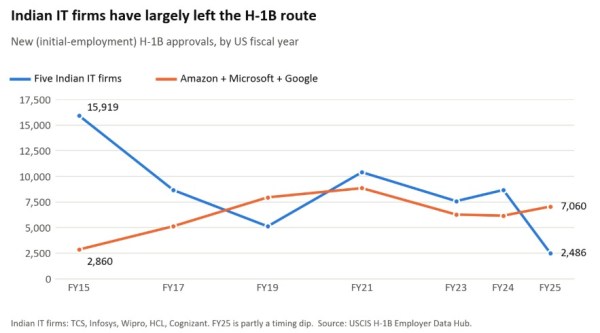
Indian IT’s retreat from visa-dependent delivery predates this crackdown. New H-1B approvals for TCS, Infosys, Wipro, HCL and Cognizant fell 84 per cent, from 15,919 in FY2015 to 2,486 in FY2025. Their share of initial-employment approvals dropped from 14 per cent to 2.2 per cent. Over the same period, approvals for Amazon, Microsoft and Google rose from 2,860 to 7,060. Indian firms increasingly hired locally in America and delivered work offshore.
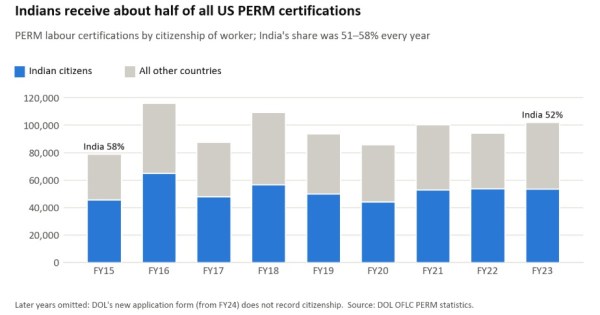
The human exposure remains substantial. Indians received 51-58 per cent of all PERM certifications in each full year from 2015 to 2023. In June 2026, 356,360 approved Indian EB-2 petitions, counting principal applicants alone, awaited visas. India received just 3,916 EB-2 green cards in FY2024. Those with approved petitions are unaffected by this suspension. The additional barrier falls on workers still seeking certification.
The US labour-market anxiety is understandable. Unemployment in computer and mathematics occupations rose from 1.9 per cent in 2022 to 3.3 per cent in 2025. Software job postings are 66 per cent below their 2022 peak. Yet restricting foreign workers does not ensure that their jobs go to Americans. Firms can move the work abroad.
Microsoft already employs more than 22,000 people in India and has committed $17.5 billion of investment over 2026–29. Adobe employs more than 8,000. These operations offer an alternative when US recruitment and retention become harder. Any gains for American workers competing directly for those roles could be offset by lost investment and work moving overseas.
The economic effect would emerge through retention and future hiring, rather than an immediate loss of existing visa holders. When permanent settlement becomes less attainable, some workers may prefer employers or countries offering greater security. Firms could then relocate teams or expand recruitment abroad to retain those skills. The risk for America is that restricting settlement changes where work gets done, without creating equivalent domestic jobs.
India is positioned to receive some of that work. Employment at global capability centres (GCCs) — the in-house operations of multinational companies — rose from 1.9 million in FY2024 to 2.36 million in FY2026. Cognizant’s Indian workforce grew from 194,700 in 2018 to 256,900 in 2025, while its North American workforce shrank from 50,000 to 41,600. The shift is already underway.
US PERM certifications
But more work in India does not automatically translate into more opportunities for fresh graduates. Net technology hiring fell from 445,000 in FY2022 to between 60,000 and 135,000 annually thereafter. In ICRIER’s survey of 651 IT firms, 65 per cent reported cutting hiring after adopting AI, while 55 per cent reduced entry-level employment and 42 per cent increased mid-level hiring. Experienced returnees and relocated roles may fit that demand better than the 820,000 engineering graduates India produces annually. Graduate unemployment remained 11.2 per cent in 2025, against 3.1 per cent across all education levels. Offshore expansion alone cannot resolve this mismatch.
There is also a longer-term cost. The US supplied 27.7 per cent of India’s $118.7 billion in remittances in 202324, about $33 billion. Fewer Indians settling there could slow future remittance growth and weaken the diaspora networks that help bring business to India. These effects would unfold gradually.
India’s response should focus on capturing higher-value work through effective GCC policy, predictable tax and transfer-pricing rules, and skills that help experienced workers use AI. Preserving mobility still matters. But the central economic task is to turn relocated work into broader opportunity. A larger offshore industry alongside a narrower American dream would otherwise leave too many young Indians behind.
For More News Updates Follow Us On www.tconews.in