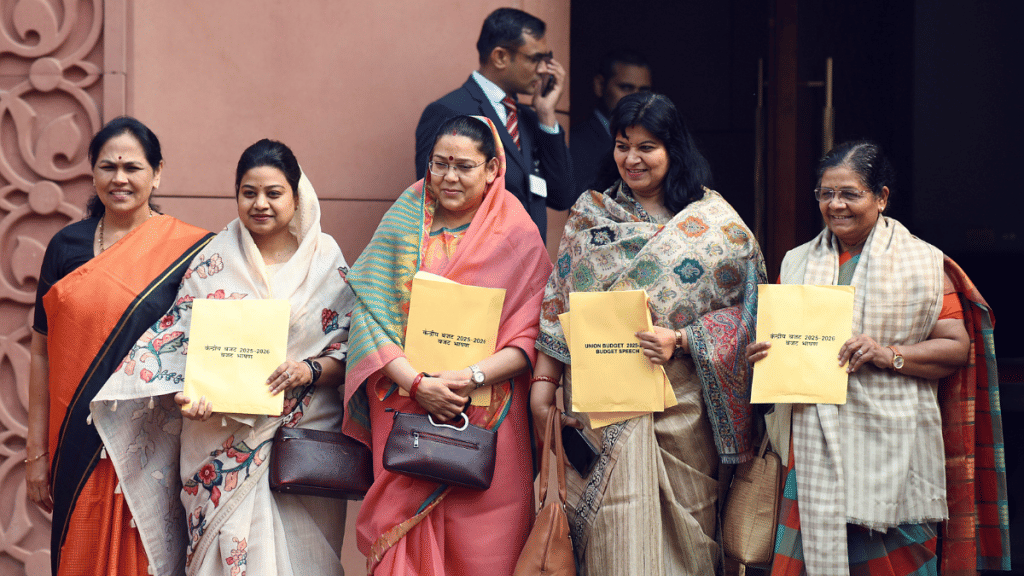
File photo of women MPs at Parliament House during the Budget Session in New Delhi | ANI
 New Delhi: The Bharatiya Janata Party (BJP) fielded only 11.04 percent women candidates while the Congress fielded only 11.83 percent women candidates in the 20 State and Union Territory Assembly elections since the passage of the Women’s Reservation Bill, 2023.
The Bill seeks to reserve one-third of the total number of seats for women in the Lok Sabha, and the State Legislative Assemblies.
In the 2024 general elections, 16 percent of BJP candidates were women, while it was 13 percent for the Congress, according to an analysis by the Association for Democratic Reforms (ADR) and the National Election Watch (NEW). The report was released on Thursday.
The report comes at a time when there are speculations that the Modi government is set to make another attempt at bringing a Constitutional amendment to operationalise delimitation and women’s reservation.
The analysis involved the scrutiny of 39,789 candidates who contested in the last Lok Sabha polls and 20 assembly elections after the passage of the 2023 law, which has not been operationalised yet, because it is contingent upon a fresh census and delimitation exercise.
It shows that the BJP did not meet the 33 percent benchmark for women candidates in any of these 21 elections. The Congress stood out as the only national party which fielded 33 percent women candidates in the 2024 Sikkim polls.
Overall, only 4,073—10.2 percent — were women candidates, the report says.
Out of the total 543 constituencies, 152 constituencies (28 percent) did not feature women candidates in the 2024 Lok Sabha polls, it says.
Among the total 1,964 candidates that the BJP fielded in 20 Assembly elections, only 217 (11.04 percent) were women. The highest percentage of 18 percent was in Jharkhand. In contrast, Andhra Pradesh and Puducherry polls did not feature any woman candidate.
As against this, Congress fielded 229 (11.83 percent) women candidates out of the total 1,935 candidates that it fielded in the assembly polls. The lowest was in Jammu and Kashmir polls: Only 1 (3 percent) of the total 39 candidates.
In all, parties fielded the least percentage of women candidates (5 percent) in Arunachal Pradesh and Jammu and Kashmir. Both the assembly elections were held in 2024.
The maximum of 14 percent was logged in Delhi (2025), Odisha (2024) and Puducherry (2026) elections.
State parties fare better
In the Lok Sabha polls, several state parties recorded higher levels of female representation. These included the Naam Tamilar Katchi (50 percent), the Biju Janata Dal (33 percent), the Rashtriya Janata Dal (29 percent), and the All India Trinamool Congress (25 percent).
The trend remained similar in the assembly elections as well.
“Among the state parties, NTK contested the Puducherry and Tamil Nadu elections and fielded 50 percent women candidates in both elections. In addition, CPI(ML)(L) fielded 56 percent women candidates in West Bengal and 33 percent in Assam,” the report says.
“The Samajwadi Party fielded 40 percent women candidates in Rajasthan. The Viduthalai Chiruthaigal Katchi fielded 50 percent women candidates in Puducherry, while the Rashtriya Lok Janshakti Party allotted 50 percent of its tickets to women candidates in Delhi,” the report said, highlighting standouts.
The defeated attempt
The Modi government brought in the Delimitation Bill 2026, the Constitution (One Hundred and Thirty-First Amendment) Bill 2026, and the Union Territories Laws (Amendment) Bill 2026 in a special sitting of the Monsoon session of Parliament, claiming that they were to operationalise the 2023 law.
Among other things, the Constitutional Amendment Bill proposed to amend Article 334A of the Constitution, which linked the women’s reservation with the next census and delimitation exercise. The new proposed provision said that the reservation will come into effect after the delimitation exercise, and shall continue for 15 years, unless extended by Parliament.
However, the Opposition rallied against the Bills, demanding that the Women’s Reservation Bill be implemented on the basis of the current strength and seat-share structure of Parliament, without linking it to delimitation exercise.
The Constitutional Amendment Bill was defeated, after which Parliamentary Affairs Minister Kiren Rijiju asked the Speaker not to take up the other two Bills as well.
For More News Updates Follow Us On www.tconews.in